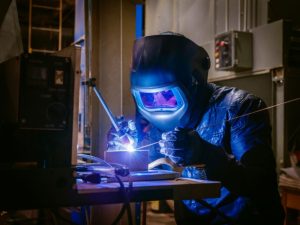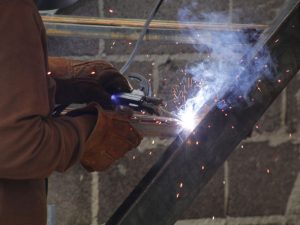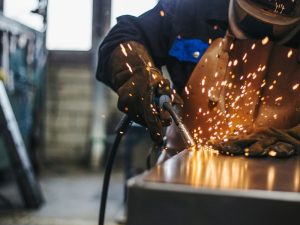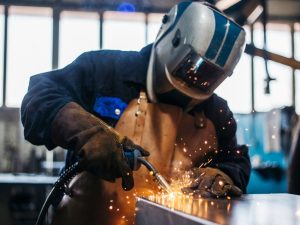
Does air quality impact worker retention and productivity in a welding shop? Probably, but the evidence is firmer for health than for financial return. This post separates what the research shows from what remains informed judgment, and it gives plant managers and owners a way to test the case with their own numbers before asking for budget.
How Poor Air Quality Affects Welders on the Shop Floor
Start with what is well established. OSHA lists eye, nose, and throat irritation, dizziness, and nausea among the effects of short-term exposure to welding fume (OSHA fact sheet). The International Agency for Research on Cancer classifies welding fume as carcinogenic to humans (Group 1), as CCOHS notes. Our article on the health risks of welding fumes covers both short-term and long-term effects.
None of that is a productivity figure, but it is the backdrop your welders work against. Many experienced welders know it, and it affects how they judge a shop and whether they plan to stay.
Does Air Quality Affect Worker Productivity?
There is good research linking air quality to output, although none of it studies welders. An economics study of indoor workers at a California pear-packing facility found that higher fine particulate (PM2.5) levels reduced packing speed, including at levels below air quality standards (Chang et al., 2016). The particles came from outdoor air and not from welding. The study therefore shows that particulate and output can be linked, without telling you how much a welding shop would gain.
Fume also settles on equipment and adds cleaning and maintenance work. Our article on how welding fume particles impact productivity and equipment covers that side, and this post stays on people.
Air Quality and the Growing Welder Shortage
Retention matters more when replacements are hard to find. The American Welding Society projects that the United States will need about 320,500 new welding professionals by 2029, or roughly 80,000 openings a year (AWS Welding Workforce Data). In sectors with tight schedules and certified-welder requirements, such as automotive, truck, and heavy equipment manufacturing, an empty welding station has an immediate cost.
Pay and benefits follow the market. Working conditions are the part of the offer your shop controls directly.
How Air Quality Affects Recruiting and Retention
If your hiring process includes a floor tour, candidates see your air quality before they hear your offer. Visible haze, dust on surfaces, or respirators worn for routine work all say something about how a shop manages exposure. Your current welders see the same things every shift.
This is reasoning from how people judge workplaces and not a measured result. You can check it against your own records, though, and that is where the next section starts.
How to Build the Case for Better Air Quality in Your Shop
Before you ask for budget, pull the numbers you already have:
- Turnover and time-to-fill for welding positions, by area if you can split it
- Absences and short-notice call-outs, with the reasons people give
- Rework and output at your highest-fume stations compared with cleaner areas
- What exit interviews and candidates’ questions on floor tours say about conditions
- Particulate readings at those stations, if you monitor them
Then pilot before you overhaul. Add source capture at the highest-fume stations first, using central extraction systems, stationary extraction systems, or mobile filter units to suit your layout, and add general ventilation where fume drifts across the wider floor. A wearable monitor such as the Dustlight can supply the before-and-after readings. Compare the same measures after a quarter or two, and let the results decide how far to go. To narrow the options, see how to choose a welding fume extraction system.
None of this guarantees a change in turnover or output. It does give you a documented before-and-after, which usually persuades a finance team more than an industry statistic.
Getting Started With Better Air Quality in Your Shop
If you want help choosing which stations to start with, KEMPER’s team can review your layout and welding processes with you. Contact KEMPER’s team to discuss your facility.