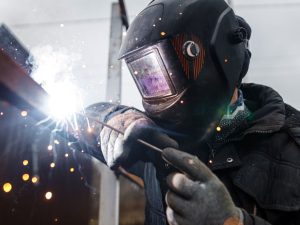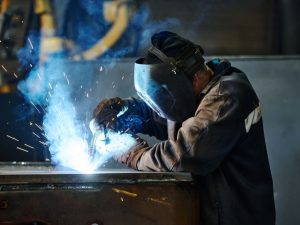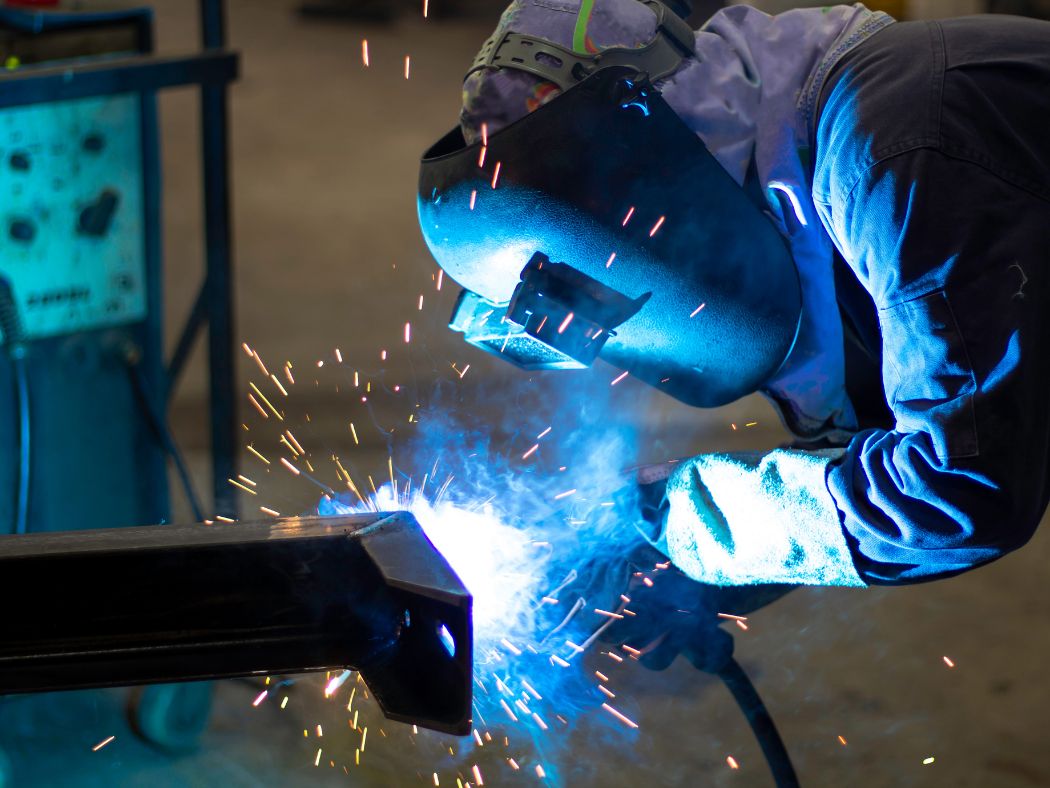
A workplace air quality safety program is a written plan for the fumes, smoke, and dust your shop produces. It records which controls handle each hazard, who checks that they work, and when the plan gets reviewed. If you’re the safety, operations, or shop manager tasked with building one, the five steps below take you from the first walk-through to the annual review.
A three-bay repair shop and a metal fabrication and general manufacturing plant follow the same steps, only at different scale.
What Is a Workplace Air Quality Safety Program?
Two clear pages should answer these questions:
- Who owns the program, and who covers when that person is away?
- Which stations, processes, and materials does it cover?
- Which control protects each station, and how will you know it works?
- Who gets trained, and when does the program get reviewed?
Which rules apply depends on where you work. In the United States, welding falls under 29 CFR 1910 Subpart Q for general industry and Subpart J of 29 CFR 1926 for construction, and chromium (VI) has its own standard (OSHA’s fact sheet lists them). In Canada, each province and territory sets its own occupational health and safety rules, so exposure limits differ (CCOHS has guidance). Our article on OSHA, ACGIH, and exposure limits goes deeper.
Step 1: Assess Your Fume and Dust Sources
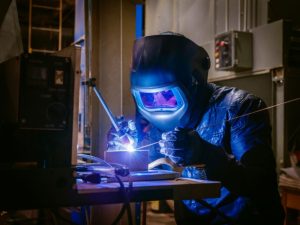
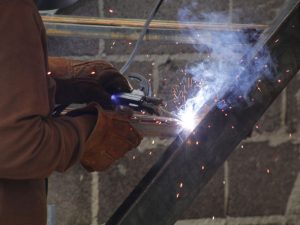
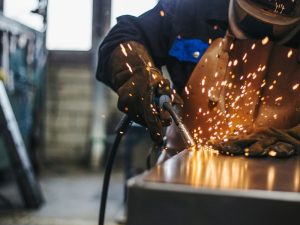
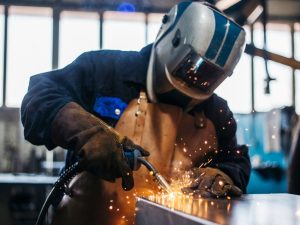
Walk the floor and list every station where you weld, cut, or grind. For each one, note the process (MIG, TIG, stick, or flux-core), the base metal and coating, and whether the station is fixed or moves.
Stainless steel, other alloys, chromate coatings, and some consumables contain chromium that converts to hexavalent chromium, Cr(VI), during welding, and OSHA regulates it under 29 CFR 1910.1026. Galvanized steel releases zinc, which is associated with metal fume fever. A certified industrial hygienist can sample your highest-risk stations.
Step 2: Apply the Hierarchy of Controls
Work down the hierarchy of controls, starting with the fume itself: a lower-fume process or consumable, or cleaning paint and solvent residue off the surface, as OSHA’s fact sheet suggests.
That makes engineering controls the core of the program: source capture at the arc, plus general ventilation, such as the CleanAirTower, for what escapes. High-vacuum extraction works through the torch or a nozzle, stationary extraction systems serve a dedicated bay, central extraction systems serve a row of stations, and mobile filter units follow a crew. For layout questions, see our guide to choosing a welding fume extraction system.
Step 3: Monitor Air Quality and Track Results
Air quality monitoring works best when you decide what to measure first. Particle monitors show when and where dust rises. Sampling by a qualified person shows what is in the air and how it compares with exposure limits, and regulated metals such as hexavalent chromium need it because a particle count can’t identify metals.
The Dustlight is a wearable monitor that tracks PM1, PM2.5, and PM10 particulate at the welder, alerts them in real time, and stores readings in an app. Log readings by station and date, with notes on what changed.
Step 4: Write Clear Policies and Train Your Team
Turn the plan into short policies, each with an owner and a due date. Cover PPE, equipment use and positioning, problem reporting, and who inspects hoses and filters per the manufacturer’s guidance. Train every welder before their first shift, retrain on a set schedule and whenever equipment or processes change, and keep a log.
Step 5: Review and Improve the Program
Review the program at least once a year, and sooner after an incident, a near miss, or a change such as a new alloy or a rearranged floor. Ask your welders what’s working, since they notice a hose that never reaches the joint long before a reading does.
Where KEMPER Can Help With Your Program
KEMPER was founded in Germany in 1977 and specializes in welding fume extraction. Its North American team can help match equipment to your layout, from design through installation. Contact KEMPER North America with your station list from Step 1.